



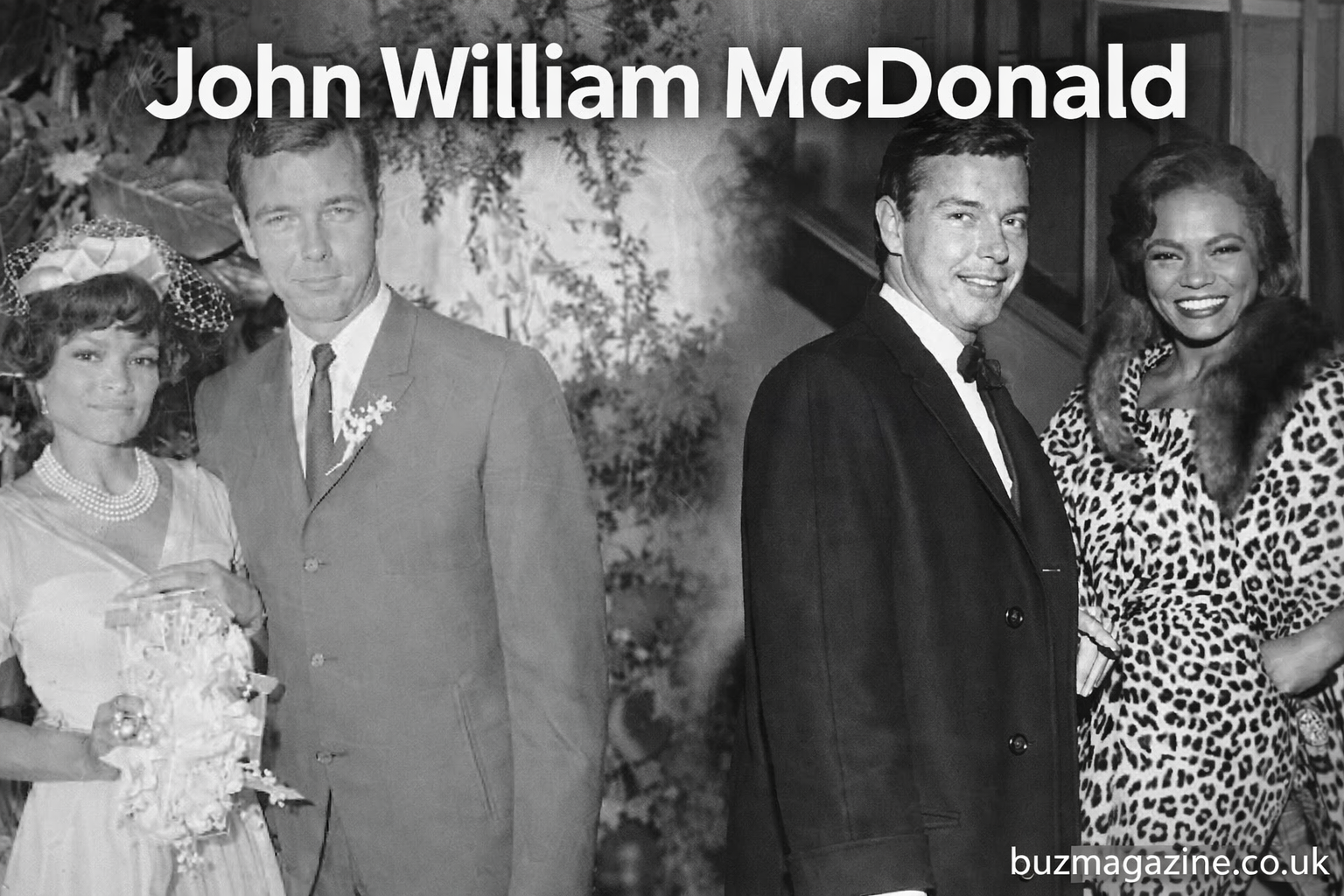
When most people hear the name John William McDonald, it may not ring a bell. Yet his life story — shaped by war, love, hardship, resilience, and quiet determination — is nothing short of remarkable. Best known as the ex‑husband of legendary singer and actress Eartha Kitt, McDonald was far more than a footnote in someone else’s biography. He was a Korean War veteran, a dedicated businessman, and a father whose influence lived on through his family.
In this article, we explore his life in depth: from his early years in Los Angeles, to battlefields overseas, from the highs and lows of marriage to Eartha Kitt, to his life after divorce and the legacy he left behind.
Introduction
John William McDonald represents a unique and poignant American story — a life lived largely outside the spotlight, yet intertwined with both historic sacrifice and celebrity culture. This article reveals his journey in full, offering insights that go beyond the simple label of “Eartha Kitt’s ex‑husband.”
Early Life and Background
Birth and Family Heritage: Irish‑German Roots in Los Angeles
John William McDonald was born on April 12, 1923, in Los Angeles, California, into a family of Irish‑German descent. The early 20th century was a time of rapid growth for Los Angeles, and McDonald’s childhood coincided with substantial cultural and economic shifts.
Raised in a stable, middle‑class household that valued discipline, education, and responsibility, young John absorbed lessons rooted in hard work and self‑reliance. Although specific records of his childhood are scarce, descriptions of his early life consistently describe a boy shaped by traditional family values and a community that prized perseverance.
Childhood, Upbringing, and Family Values
During the Great Depression — a defining era for many Americans — McDonald’s formative years were marked by financial uncertainty and social instability. These experiences instilled in him a deep appreciation for stability, financial security, and preparation for life’s challenges.
Family members and early friends recalled John as introspective and thoughtful from a young age, a boy whose quiet nature belied an inner resilience that would later become central to his character.
Education: Accounting at the University of Southern California
John’s academic journey led him to the University of Southern California (USC), where he studied accounting. This choice reflected both his analytical mind and his desire for a respectable, secure profession.
USC, even in the mid‑20th century, was and remains one of the nation’s most respected universities, and McDonald’s enrollment there suggests strong academic ability and solid preparation during his earlier years.
Military Service
Enlistment in the U.S. Army
After completing his degree, McDonald enlisted in the U.S. Army, answering a call to service in a world still reeling from political upheaval. Like many young men of his generation, he felt a deep sense of duty.
His service would eventually take him to the battlefields of the Korean War, a conflict that lasted from 1950 to 1953 and involved hundreds of thousands of American troops.
Korean War Experience and Challenges
The Korean War was one of the most brutal conflicts of the 20th century — marked by extreme terrain, ruthless combat, and unpredictable conditions. McDonald was sent overseas to serve, and it was during this time that his life changed irrevocably.
During a fierce engagement, he was severely wounded by a grenade explosion, an injury so devastating that it required more than 25 surgeries over the ensuing years. These surgeries were not cosmetic — they were life‑saving and reconstructive, reflecting the severity of his wounds.
His injuries had both physical and psychological dimensions, leaving him to grapple with chronic pain, long periods of rehabilitation, and the emotional impact of combat.
Severe Injuries and Over 25 Surgeries
Surviving a grenade blast of that magnitude was itself extraordinary. Undergoing 25+ surgeries speaks to both the brutality of the injury and McDonald’s determination to recover and return to civilian life.
Many veterans of that era faced similar challenges: incomplete medical understanding of long‑term trauma, limited pain management options, and significant social pressure to resume “normal life” quickly. McDonald’s resilience during this period became one of the defining arcs of his life.
Physical and Emotional Aftermath
Recovering from war injuries is never just a physical journey — it’s emotional and spiritual as well. McDonald faced chronic pain throughout his life, a factor that later contributed to long‑term medication use and personal challenges that affected his later relationships.
Yet through it all, he maintained his dignity and sense of purpose, eventually returning home determined to build a new life.
Career and Professional Life
Early Career in Accounting
Once his recovery allowed, McDonald transitioned into civilian life by returning to his roots in business and accounting. With a degree from USC and a mind sharpened by discipline and focus, he entered the world of finance quietly but effectively.
Though never seeking public recognition, he developed a reputation among peers for precision, reliability, and professionalism.
Transition to Real Estate Investment
Beyond accounting, McDonald expanded into real estate investment — a field that allowed him to combine analytical skill with hands‑on entrepreneurial thinking.
Real estate in mid‑20th century California was a growing market, and McDonald’s involvement reflected both practical ambition and an ability to navigate complex financial landscapes.
Reputation for Integrity and Hard Work
While not a headline‑grabbing businessman, McDonald earned respect in professional circles as someone who treated his business seriously, ethically, and privately. He was known as a man who preferred results to recognition — a theme that would repeat throughout his life.
Achievements and Financial Life
There are no public records showing an exact net worth for McDonald, and he kept his financial life private. However, his lifelong work in accounting and real estate suggest that he achieved stable financial security, a key goal for someone who had experienced the instability of war.
Meeting Eartha Kitt
First Encounter in Las Vegas Through Bob Dix
In 1957, McDonald’s life took an unexpected turn when he met Eartha Kitt in Las Vegas through mutual friend and actor Bob Dix.
At the time:
- Eartha was emerging as an international star — known for her sultry voice, dazzling performances, and magnetic stage presence.
- John was quietly rebuilding his life, still facing the daily reminders of his war injuries.
The meeting was not dramatic, but it was meaningful — two people with very different worlds yet uniquely shared experiences of struggle and resilience.
Developing Friendship into Love
Although Eartha initially showed interest in Bob Dix, it was McDonald’s grounded, steady personality that captured her attention. They formed a friendship built on mutual respect.
Over time, that friendship deepened into love — a connection rooted not in fame or glamour, but in shared emotional depth and understanding.
Marriage to Eartha Kitt
Wedding Details and Societal Context of Interracial Marriage
John William McDonald and Eartha Kitt married on July 6, 1960 in a small, private ceremony attended by a few close friends and family.
This union was significant beyond their personal story. At a time when interracial marriage was still controversial in many parts of the United States, their wedding represented both personal courage and cultural progress.
The ceremony was modest — reflective of McDonald’s private nature — and signaled a genuine partnership in a world often skeptical of couples who crossed racial boundaries.
Life as a Couple: Balancing Fame and Private Life
While Eartha’s career surged — including records, films, and international tours — McDonald continued his work behind the scenes.
Their relationship was described by those close to them as grounded in:
- Mutual respect
- Emotional support
- A desire to build a stable family life
Yet it was also tested by the very forces that gave their union meaning — distance, career pressures, and the clash between fame and quiet routine.
Parenthood: Birth of Daughter Kitt McDonald (Kitt Shapiro)
Their daughter, Kitt McDonald (later known as Kitt Shapiro), was born on November 26, 1961 in Los Angeles.
Her birth brought joy to both parents and added a new dimension to their relationship. For Eartha, motherhood became a central focus — one she embraced fully. McDonald, meanwhile, provided quiet stability and support, striving to create a balanced home environment amid the complexities of celebrity life.
Challenges in Marriage
Career Pressures and Long‑Distance Struggles
Eartha’s rapid career ascent meant frequent travel, long tours, and extended periods away from home. McDonald’s world, on the other hand, remained rooted in business and family responsibilities.
This imbalance — inevitable given their different paths — placed strain on the marriage, creating distances that neither fully anticipated.
John’s War Injuries and Painkiller Use
A less public but deeply impactful challenge was McDonald’s struggle with pain resulting from his war injuries.
To manage chronic discomfort, he relied on prescription medicine, including powerful painkillers. Over time, this led to medication dependence — a common yet tragic experience among veterans of his generation.
Though not widely discussed during his lifetime, this struggle affected McDonald’s emotional well‑being and, by extension, his relationship with Eartha.
Social Pressures and Emotional Strain
The combination of:
- racial bias
- cultural expectations
- personal hardship
— placed unique and ongoing stress on the marriage.
In court filings, Eartha later cited “mental cruelty” as the reason for divorce, a phrase often used legally at the time to describe irreconcilable emotional distance rather than overt animosity.
Divorce and Life After
Reason for Divorce and Court Proceedings
The couple divorced in 1964, just four years after their marriage. Eartha was granted full custody of their daughter, and McDonald chose not to contest the proceedings.
While painful, the divorce reflected complex personal realities — not a lack of love, but the pressures of life circumstances that grew too heavy for the relationship to sustain.
Life Post‑Divorce: Quiet Living, Remarriages, and Second Family
After the divorce, McDonald withdrew further from the public eye. He focused on his work and personal healing, prioritizing peace over publicity.
He would later marry twice, including once to a Filipina woman, and have a son named Chad. His later family life remained private, stable, and removed from the glare of media attention.
Relationship with Children After Divorce
Though he lived apart from his daughter’s upbringing, McDonald maintained a meaningful presence in both his children’s lives. Friends describe him as a caring father who, despite distance and struggle, offered support whenever possible.
Later Years and Passing
Health Issues and Aging
In his later years, McDonald’s health was still shaped by the enduring impact of his wartime injuries. Though he aged with dignity, chronic pain and the cumulative stress of a complicated life took their toll.
Death in Los Angeles at Age 82
John William McDonald passed away on May 12, 2005, in Los Angeles, the city where his remarkable life began. He was 82 years old.
True to his lifelong preference, his passing was peaceful and kept out of public spectacle. Details about his burial remain largely private, reflective of the humble life he lived.
Reflection on a Life Lived Privately
McDonald’s story doesn’t end in tragedy or fame — it ends in quiet reflection, dignity, and the legacy he built outside the spotlight.
Legacy
Influence on Daughter Kitt Shapiro
One of the greatest testaments to McDonald’s legacy is his daughter, Kitt Shapiro — an author, speaker, and businesswoman who honored both her parents’ stories.
In her memoir Eartha & Kitt: A Daughter’s Love Story in Black and White, she reflects on the complexities of identity, family, race, and resilience that shaped her upbringing.
Through her work — including advocacy and creative projects — McDonald’s quiet influence continues to resonate.
Lessons of Resilience, Courage, and Quiet Heroism
What makes McDonald’s life meaningful is not celebrity or notoriety, but the qualities he embodied:
- perseverance in pain
- integrity in work
- devotion to family
Even when history overlooks those qualities, they matter — especially to those who knew and loved him.
Cultural Reflection: Love, Race, and Life Behind the Spotlight
McDonald’s life intersects with broader American themes:
- the Korean War and veterans’ struggles
- interracial marriage during a time of prejudice
- the balance between public achievement and private meaning
His story reminds us that the people behind icons are often heroes in their own right.
Net Worth and Financial Life
Unlike many celebrities, McDonald’s financial achievements were never publicized. His wealth was modest and derived from traditional careers — accounting and real estate — rather than fame or media attention.
While he did not leave behind a vast estate, he left something arguably more significant: a legacy of resilience, love, and quiet strength.
Frequently Asked Questions (FAQs)
1. Who was John William McDonald?
John William McDonald was an American accountant, real estate investor, Korean War veteran, and the ex‑husband of Eartha Kitt.
2. When and where was he born?
He was born on April 12, 1923, in Los Angeles, California.
3. What was his career background?
After military service, he worked in accounting and real estate investment, earning a reputation for integrity and dedication.
4. How did he meet Eartha Kitt?
He met Eartha Kitt in Las Vegas in 1957 through mutual friend Bob Dix.
5. When did they marry and divorce?
They married in July 1960 and divorced in 1964.
6. Did he have children?
Yes — his daughter with Eartha is Kitt McDonald (Kitt Shapiro), and he later had a son, Chad.
7. When did he die and how is he remembered?
He passed away on May 12, 2005, in Los Angeles. He is remembered as a resilient, humble man who lived a life of quiet dignity.
Conclusion
John William McDonald’s story is one of resilience, love, sacrifice, and quiet strength. Though he lived largely outside the glare of fame, his life intersected with history, culture, and deep personal challenges.
He was a soldier, a businessman, a father, and a partner whose legacy continues through his children and through the meaningful, uncelebrated life he lived.
In understanding McDonald, we gain not just the life of a man — but a deeper appreciation for the unsung figures whose courage arrives not on stage, but in the unnoticed moments that truly define us.